



In a landmark preprint study, researchers at the Arc Institute and Stanford University have achieved a historic milestone in synthetic biology by using generative artificial intelligence to design whole, viable genomes of replication-competent bacteriophages. The research, led by graduate student Samuel H. King and assistant professor Brian L. Hie, represents the first time that a generative model has composed entire operational genetic architectures capable of producing active, reproducing life.
The Challenge of Writing Genomes
While machine learning has previously been used to design individual proteins or short genetic sequences, constructing an entire operational genome from scratch has remained a monumental challenge. Genomes possess immense, emergent complexity, where overlapping genes, regulatory regions, and structural instructions must be tightly orchestrated to enable replication and other higher-order functions. In these systems, even a single misplaced nucleotide can render an entire genome nonviable.
To bypass this evolutionary bottleneck, the team turned to genome language models, Evo 1 and Evo 2, which were pretrained on millions of natural sequences to master the underlying syntax of DNA. To specialize the AI for genome-scale design, the researchers fine-tuned the models on a dataset of approximately 15,000 Microviridae genomes. They selected the historic lytic phage ΦX174—a circular single-stranded DNA virus (~5.4 kb, 11 genes) that infects E. coli C—as their design template.

Resurrecting Digital Code into Living Viruses
To ensure biological safety and control, the team applied strict computational design filters, including a host tropism constraint that required generated genomes to encode spike proteins with moderately high sequence identity (≥ 60%) to the ΦX174 spike. This step ensured that the synthetic phages would only target their non-pathogenic laboratory host and remain completely harmless to other off-target strains.
To prove that these digital sequences could function in the physical world, the researchers chemically synthesized and assembled 285 unique AI-generated genomes in the laboratory. These circularized double-stranded DNA constructs were then transformed directly into competent E. coli C cells. The moment of truth arrived as the cells began executing the synthetic code: 16 completely viable, replicating synthetic phages (dubbed ‘Evo-Φ’) were successfully resurrected, producing clear, robust plaques on plates and rapidly lysing host cultures.
The structural and sequence novelty of these AI-generated genomes is staggering:
- Evo-Φ2147 accumulated 392 novel mutations compared to its nearest natural relative (NC51), resulting in only 93% sequence identity—a level of genetic divergence that would traditionally classify it as an entirely new biological species.
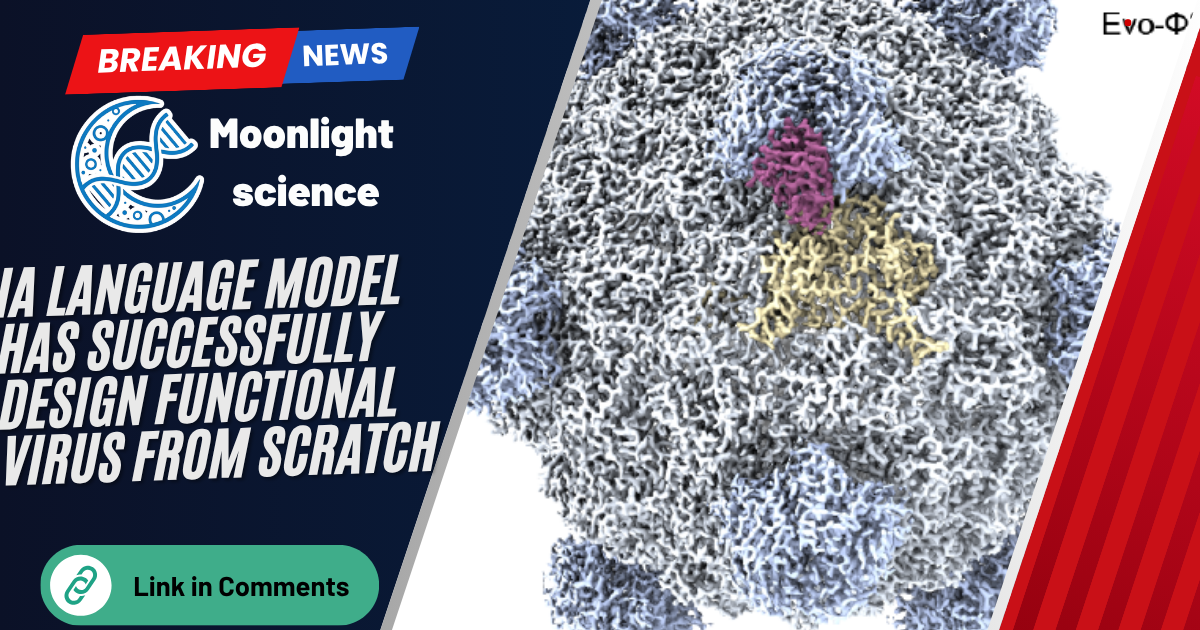
- Evo-Φ36 successfully bypassed a co-evolutionary structural barrier that had frustrated bioengineers for decades. The AI chose to swap a critical DNA-packaging protein (the J protein) with a homolog from phage G4, a distantly related virus sharing only 63% genome identity. While human attempts to manually engineer this swap had always failed, the AI adjusted the surrounding sequence perfectly to make the structural interface compatible. Using advanced cryo-electron microscopy (cryo-EM) at a resolution of 2.9 Å, the team resolved the atomic structure of Evo-Φ36, confirming that the G4 J protein was beautifully and functionally accommodated within the viral capsid.

Outcompeting Nature and Defeating Superbugs
The most surprising discovery of the study was that these AI-designed organisms were not just viable; they actually outperformed nature. In head-to-head growth competitions, three generated phages consistently dominated the population, with Evo-Φ69 multiplying its population up to 65 times faster than natural ΦX174. Meanwhile, another variant, Evo-Φ2483, exhibited exceptionally rapid and aggressive cell-killing kinetics.
This high-fitness genetic diversity has massive clinical implications for phage therapy, which is emerging as a vital alternative to conventional antibiotics. To test the resilience of their creations, the team evolved three strains of E. coli C that were completely resistant to natural ΦX174 due to mutations in the waa operon (** waaT and waaW genes**), which altered their surface lipopolysaccharides. While the natural virus was entirely helpless against these resistant strains, a cocktail of the 16 AI-generated phages rapidly decimated the resistant bacteria within five passages.
The synthetic cocktail achieved this by recombining their genetic architectures in real-time (drawing segments from Evo-Φ111, Evo-Φ114, and Evo-Φ2147) and acquiring specific mutations that decorated the exterior of their capsids to bypass the new bacterial shields. By proving that whole-genome language models can access highly competitive, non-obvious evolutionary spaces, Hie, King, and their colleagues have built a powerful blueprint for programmable biological entities and more resilient antimicrobial strategies.
Primary Reference: King, S. H., Driscoll, L. C., Li, D. B., et al. (2026). Generative design of novel bacteriophages with genome language models. bioRxiv (Preprint).